
Washing machine door robot cleaning station with SE-ARN-80
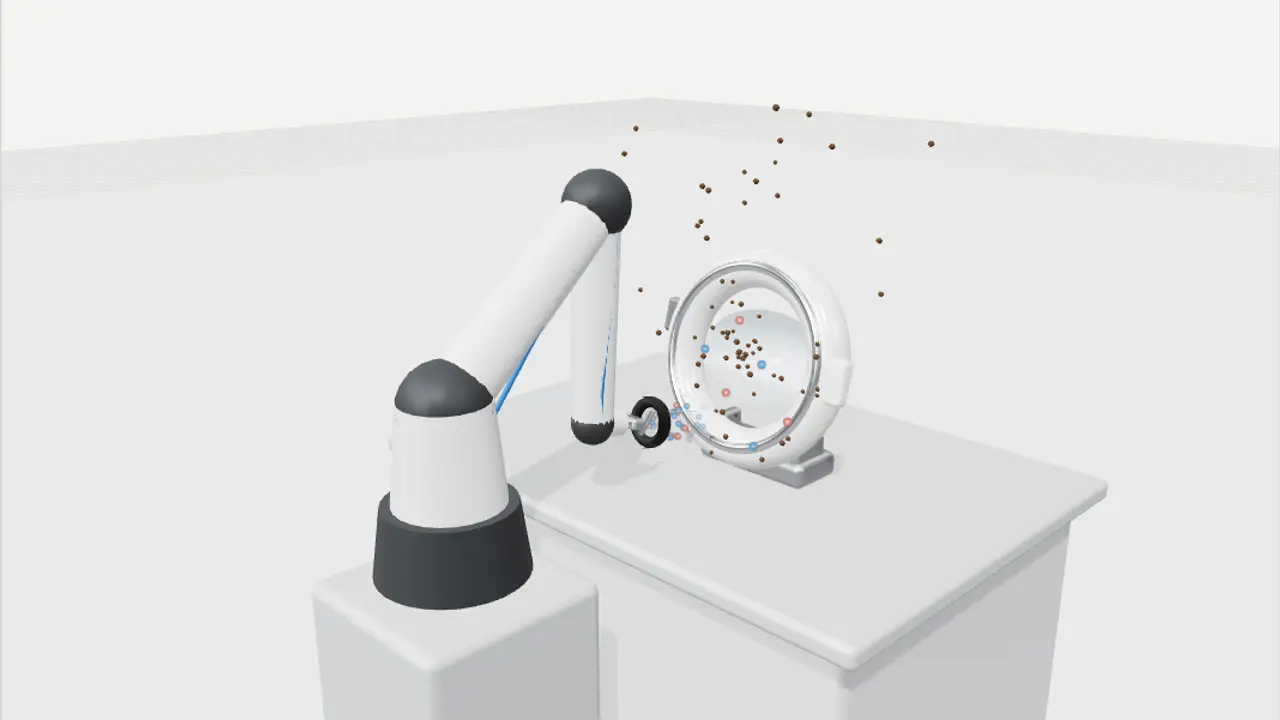
High-gloss plastic and glass washing machine doors charge up during moulding and transport and become a magnet for dust and lint — visible surface defects after assembly. Robotic handling alone does not help: the static bond holds the dust, simple air blowing cannot release it. A robot carrying an SE-ARN-80 rotating ionizing air nozzle follows the contour of the door — round the ring and over the glass — and the ionized air breaks the bond so the particles are swept away.
The problem
Washing machine doors, typically made of high-gloss plastic or glass, are highly prone to static buildup during the molding and transport phases. On an automated assembly line, this static acts as a powerful magnet for dust, lint, and airborne debris. If these contaminants are not removed before the door is assembled or packaged, it leads to visible surface defects and perceived poor quality. Standard robotic handling doesn't solve this, as the static bond holds the dust firmly to the surface, making it resistant to simple air blowing.
The solution
A robotic arm equipped with an ionizing air nozzle or specialized static-eliminating cleaning head targets the interior and exterior surfaces of the door. As the robot follows the precise contour of the part, it delivers a concentrated stream of ionized air that breaks the electrostatic bond holding the dust. This allows the particles to be effectively swept away, leaving the door perfectly clean and statically neutral for the next assembly step.
Application
Precision robotic cleaning and static neutralization of complex 3D plastic and glass parts in the home appliance and automotive industries.
1 · SE-ARN-80-112-C3-PA — on the robot
Mounted on the robot flange; the rotating air jets and the 8 kV AC ion field follow the contour of the door ring and the glass.
- Ionization
- 8 kV AC · shockless
- Rotary nozzle
- Body ⌀ 70 mm · nozzle hole ⌀ 1.8 mm
- Protection
- IP66 — fully sealed
- Power unit
- SE-PAC-80-2-C / SE-PAC-80-4-C
Also suitable for robot cleaning
Other FÖGE ionizers for robot-mounted cleaning of 3D parts.
Schematic model, not to scale. Machines and parts are generic — no specific manufacturer or brand.