
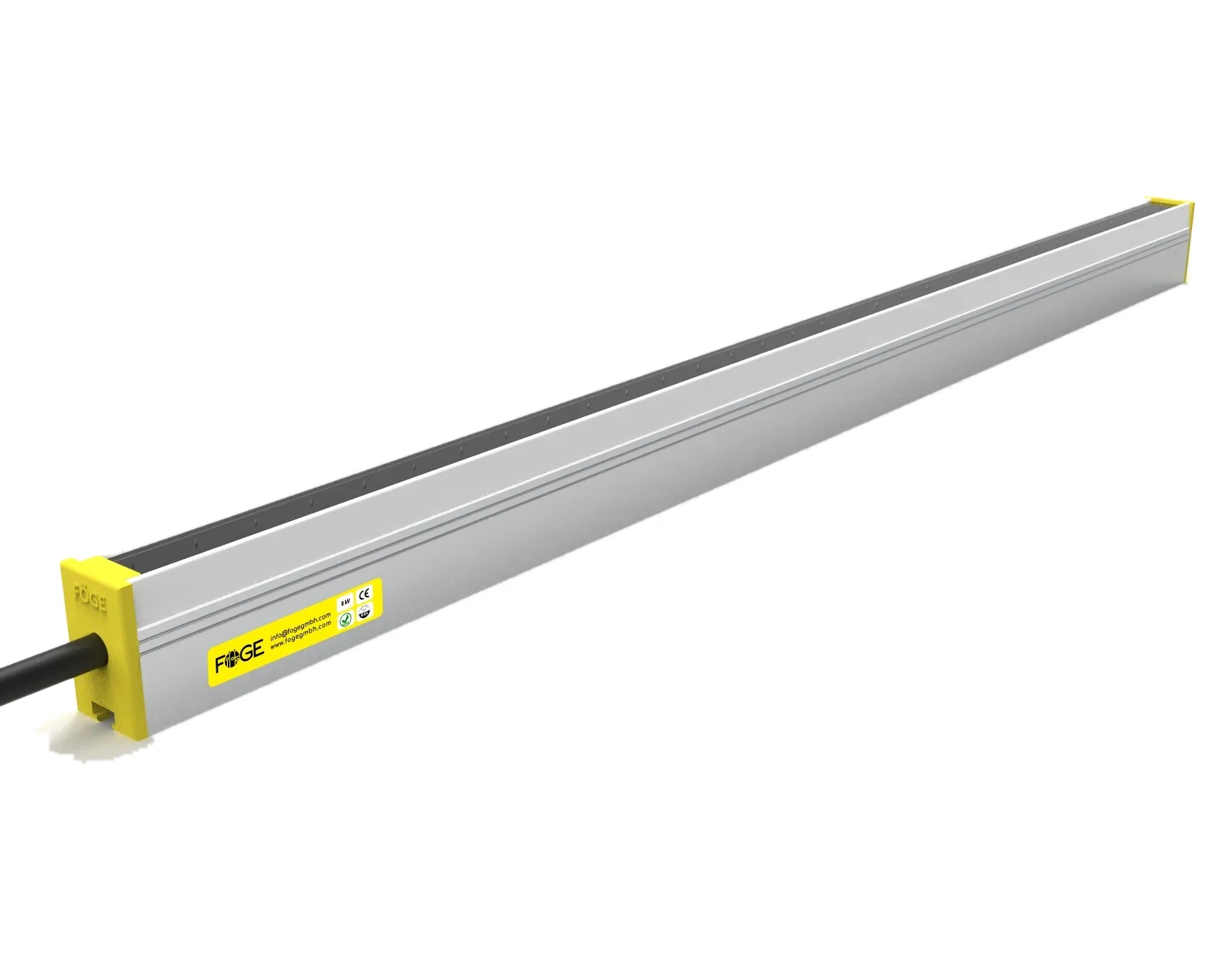
 SE-ACB-55
 Compact AC Antistatic Bar – 5.5 kV
High-speed, compact static elimination for industrial production lines
The FÖGE SE-SFM-030 is a precision handheld static electric fieldmeter for engineers, process technicians and quality managers who need to investigate, quantify and diagnose static electricity problems on industrial production lines. Static charge is invisible until it is strong enough to cause an operator shock — by which point it may already have caused dust contamination, coating failures, material misalignment or damage to electronic components. The SE-SFM-030 measures the electrostatic surface voltage on any non-conductive material at a fixed 100 mm distance, displaying the magnitude in volts and the polarity.
The meter covers 0 to 200 kV across two automatically selected ranges: 0 – 20 kV with 10 V resolution, and 20 – 200 kV with 100 V resolution. Accuracy at calibration is ±5 %. A hold function freezes the reading when the measurement position is awkward. Battery-powered and fully portable, the SE-SFM-030 is supplied with a carrying case, battery and earth cord, and is the companion tool for installing, commissioning and troubleshooting any FÖGE static elimination system.
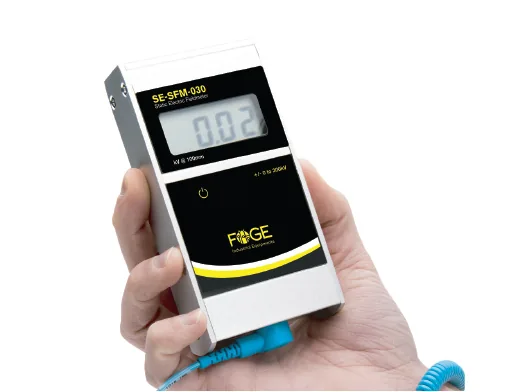
Static electricity is a coulombic charge — it forms a current when it moves, but is difficult to measure when stationary. The SE-SFM-030 measures surface voltage using Q = CV, where Q is the charge on the surface, C is the capacitance between the surface and the meter's sensor, and V is the voltage. Holding the meter at exactly 100 mm from the surface creates a constant, known capacitance. With C fixed, the voltage V varies in direct proportion to the charge Q. The sensor detects the electrostatic field at 100 mm without touching the surface, and the electronics display the corresponding surface voltage. The two measurement ranges switch automatically at the 20 kV threshold.
Identify exactly where on the production line static is accumulating — which material, process step or zone.
Quantify static in volts — from a few hundred volts up to 200 kV — to assess severity and select the correct ionization solution.
Determine whether the charge is positive or negative — essential for understanding the generation mechanism and verifying that an ionizer neutralises correctly.
Measure static before and after installing an ionizing bar or blower to confirm it neutralises charge to the required level.
Map static levels at multiple points to identify uneven distribution or localised problem areas.
Monitor how quickly static accumulates during production to determine the optimal ionization intensity and cleaning schedule.
Always connect the earth cord to a known ground point before taking measurements. An unearthed meter gives inaccurate readings.
Tip: take at least three readings at each point and average the results. Surface charge can fluctuate slightly with humidity, temperature and material movement.
| Applications | Description |
|---|---|
| Diagnosing static problems | Investigate unexplained dust attraction, coating defects, material sticking or operator shocks by mapping static levels across the machine. |
| Commissioning ionization equipment | Verify that a newly installed ionizing bar, blower or nozzle is correctly positioned and neutralising to the required level before full production speed. |
| Setting acceptance standards | Establish measurable targets (e.g. surface charge below ±1 kV) that define acceptable performance for the ionization system. |
| Routine performance checks | Periodically measure static levels at key points to confirm that ionization equipment has not degraded. |
| Troubleshooting ESD events | Locate the source of electrostatic discharge events in electronics assembly or packaging lines. |
| Pre- and post-cleaning verification | Measure static before and after cleaning antistatic bars to confirm that cleaning has restored full ionization performance. |
| Material and process investigation | Characterise how much static a material, machine operation or process speed generates — to specify the correct ionization solution from the outset. |
Don't know the exact voltage, distance and speed on your line? Talk to our application engineers — we will calculate the antistatic configuration for your project within 1 working day.
| Parameter | Specification |
|---|---|
| Product code | SE-SFM-030 |
| Measurement principle | Non-contact electrostatic field measurement at fixed 100 mm distance (Q = CV) |
| Measurement distance | 100 mm — fixed, standardised distance |
| Measurement range | 0 – 200,000 V (200 kV) — two auto-selected ranges |
| Range 1 | 0 – 20 kV · resolution 10 V |
| Range 2 | 20 – 200 kV · resolution 100 V |
| Range selection | Automatic — no manual switching |
| Accuracy | ± 5 % (at calibration) |
| Calibration | On a 150 × 150 mm charge plate (other plate sizes on request, e.g. 450 × 450 mm) |
| Drift | < 0.1 % in 10 s |
| Polarity display | Positive (+) and negative (−) |
| Hold function | Yes — freezes reading on display |
| Display | 3½-digit LCD |
| Power | 9 V PP3 battery — included; low-battery indicator; automatic switch-off after 60 s |
| Supplied with | Carrying case · 9 V battery · earth lead · certificate of calibration |
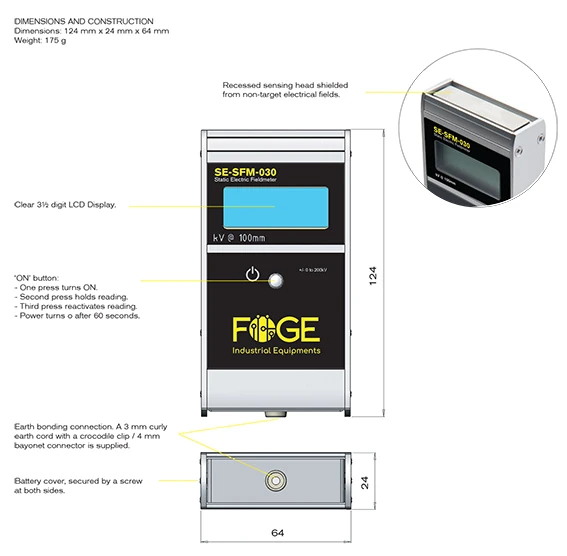
| Earth lead | 3 mm curly earth cord with crocodile clip / 4 mm bayonet connector |
| Design | Handheld — portable |
| Dimensions | 124 × 24 × 64 mm |
| Weight | 175 g |
| Construction | Anodised aluminium case, recessed stainless steel sensing plate |
| Humidity | 70 % rH, non-condensing max. |
| Certification | CE — EN-500081-1 (EMC), BS7506-2 (construction) |
| Component | Description |
|---|---|
| SE-SFM-030 fieldmeter | Handheld static electric fieldmeter |
| Carrying case | Protective case |
| Battery | Installed and ready |
| Earth cord | Grounds the meter for an accurate reference potential |
The SE-SFM-030 measures surface voltage using Q = CV. At 100 mm, the capacitance C is a fixed, known value. Holding at a different distance changes C and makes the reading incorrect. Use the distance indicator on the meter or a 100 mm spacer gauge if precise positioning is difficult.
Whether the charge is positive or negative. This reveals how the charge is being generated — certain materials and processes consistently produce one polarity — and confirms that an AC ionizer is correctly neutralising the charge.
The earth cord grounds the meter, providing the reference potential needed for accurate measurement. Without it, the meter can float at an undefined potential and give unstable or incorrect readings.
The SE-SFM-030 is designed for non-conductive materials such as plastics, films, paper and textiles. Conductive materials normally drain charge to ground and show near-zero readings.
Annual calibration by a qualified service facility is recommended for instruments in regular use. Contact FÖGE for calibration service options.
Yes. The SE-SFM-030 measures without contact at 100 mm. Maintain the correct distance and avoid contact with moving parts. For very high-speed webs, take readings from a fixed, stable position.
High-voltage equipment. Installation and maintenance by qualified personnel only, following the operating manual. Safety & compliance
SE-ACB-55High-speed, compact static elimination for industrial production lines
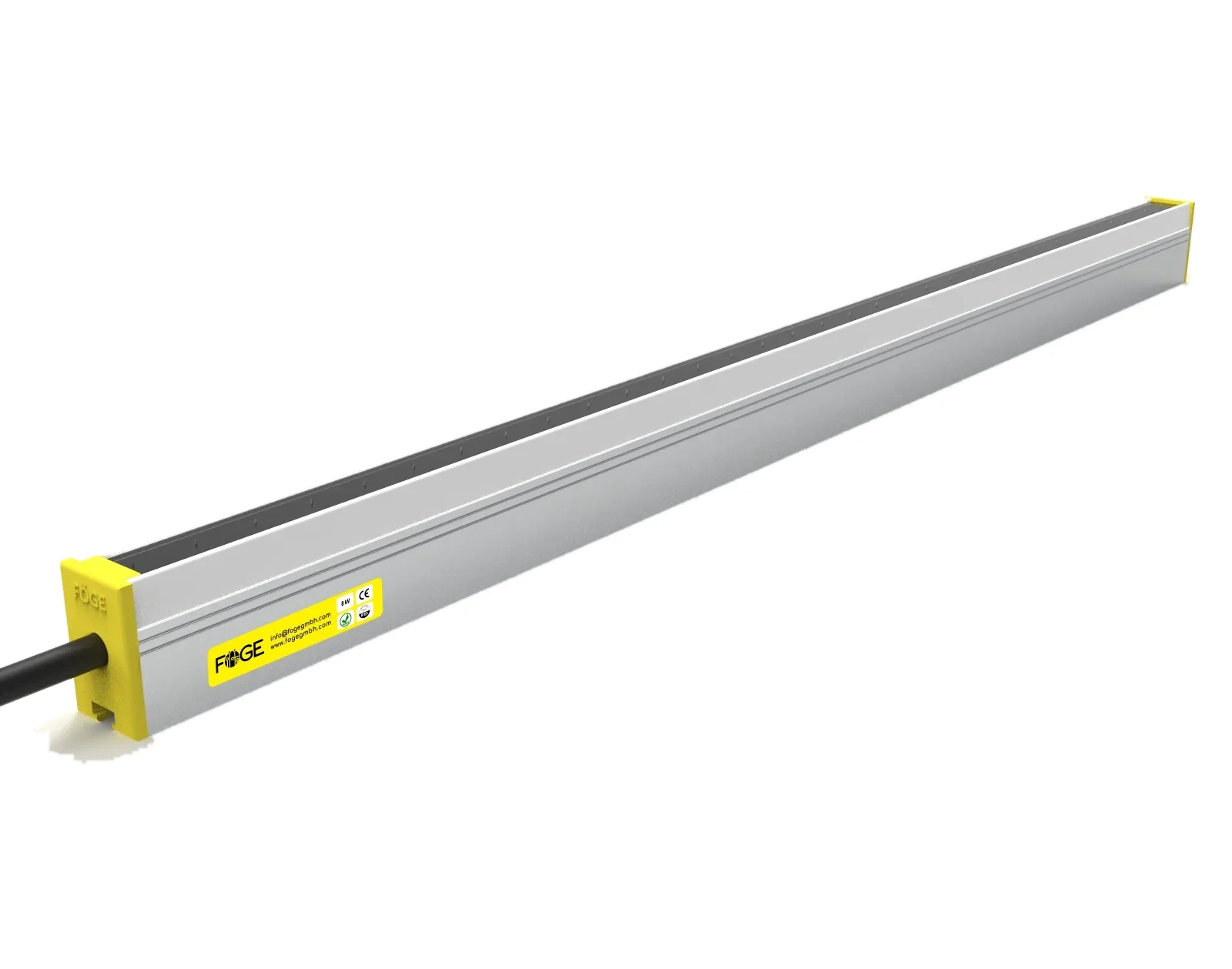 SE-ACB-80
Extended-range, high-speed static elimination for demanding industrial production lines
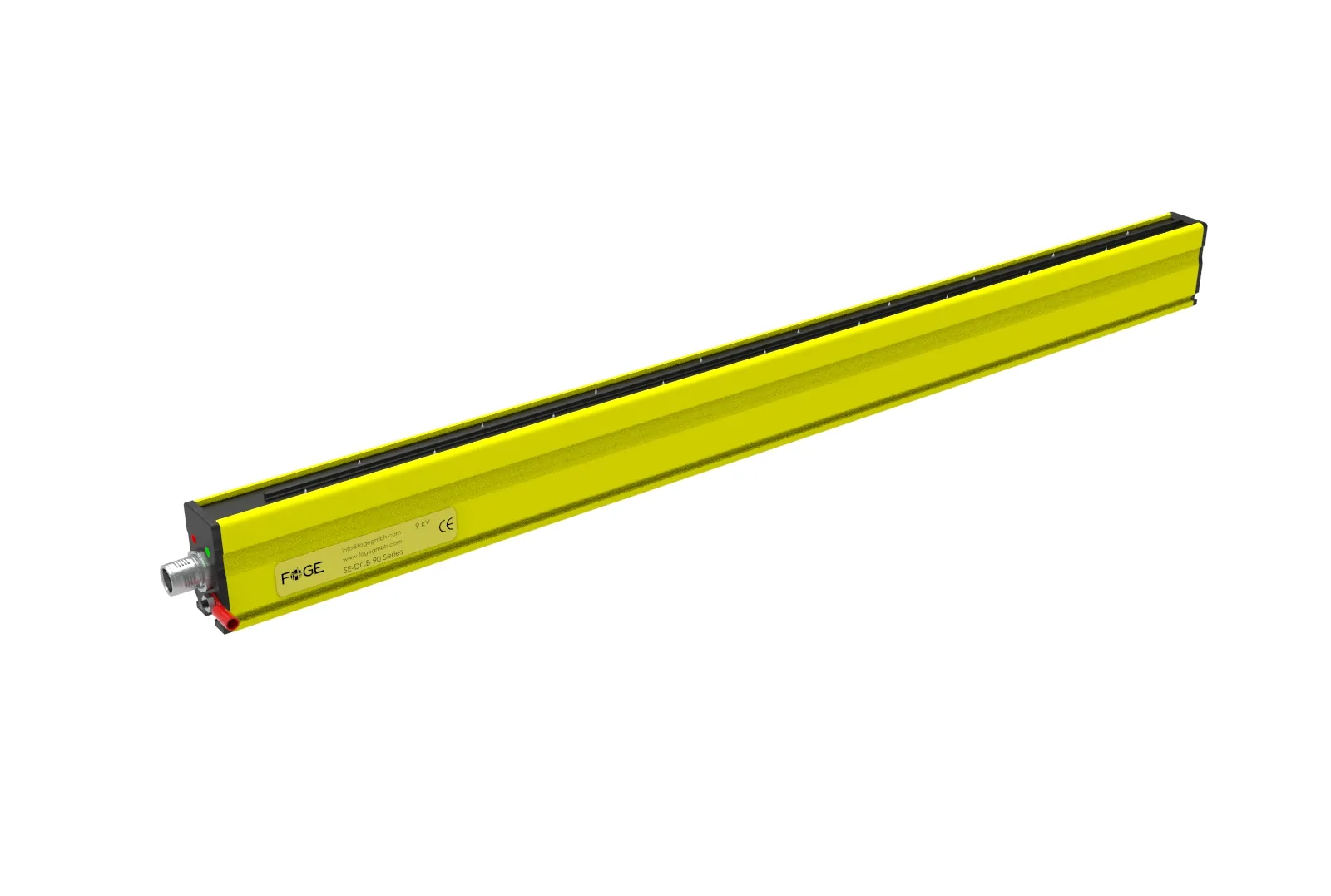 SE-DCB-90
Compact 9 kV pulsed DC static elimination — no HV transformer, 24 V DC supply, up to 200 mm range
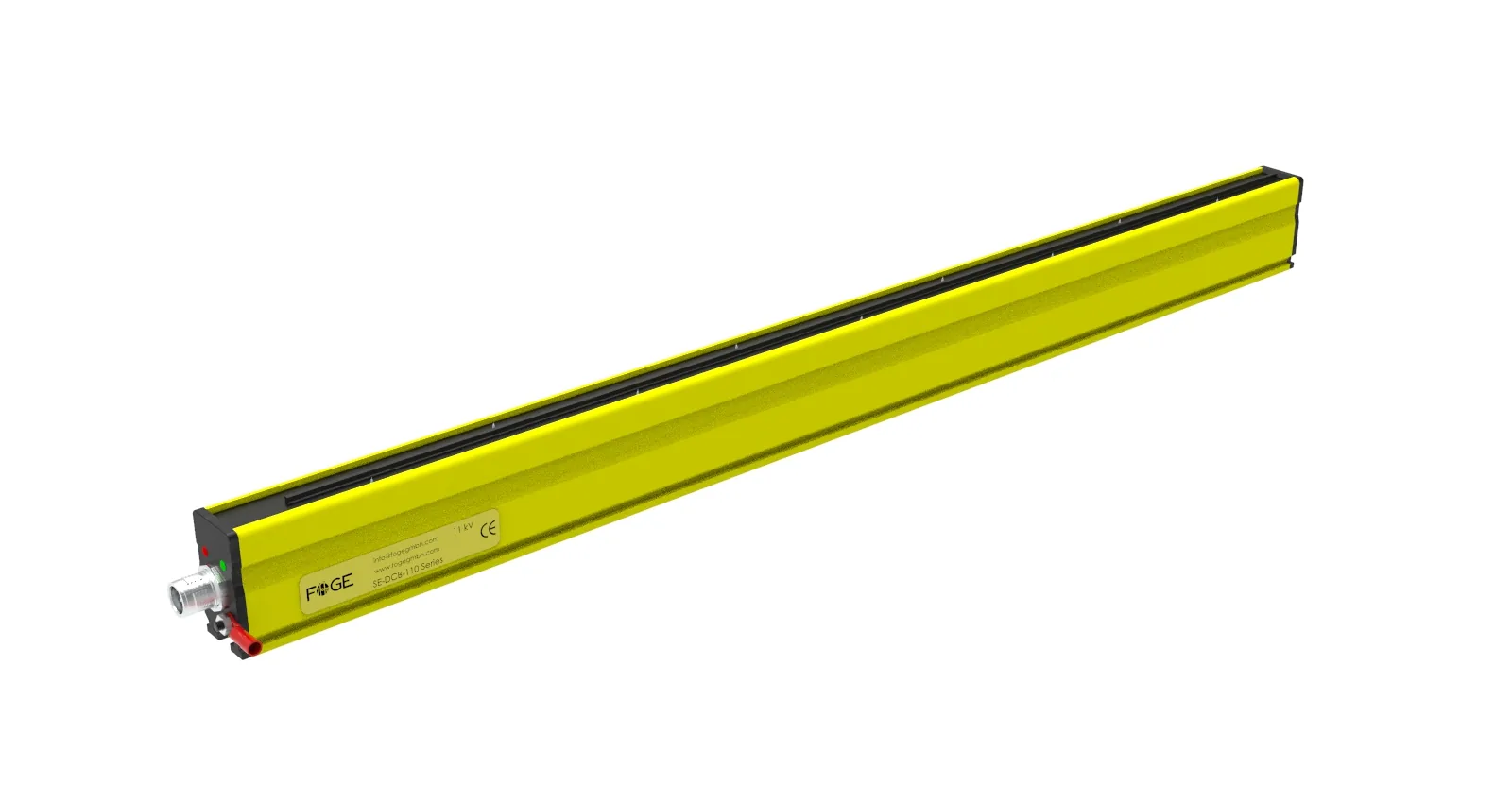 SE-DCB-110
Long-range static elimination at 100 – 600 mm — 11 kV pulsed DC, 24 V DC supply, no HV transformer