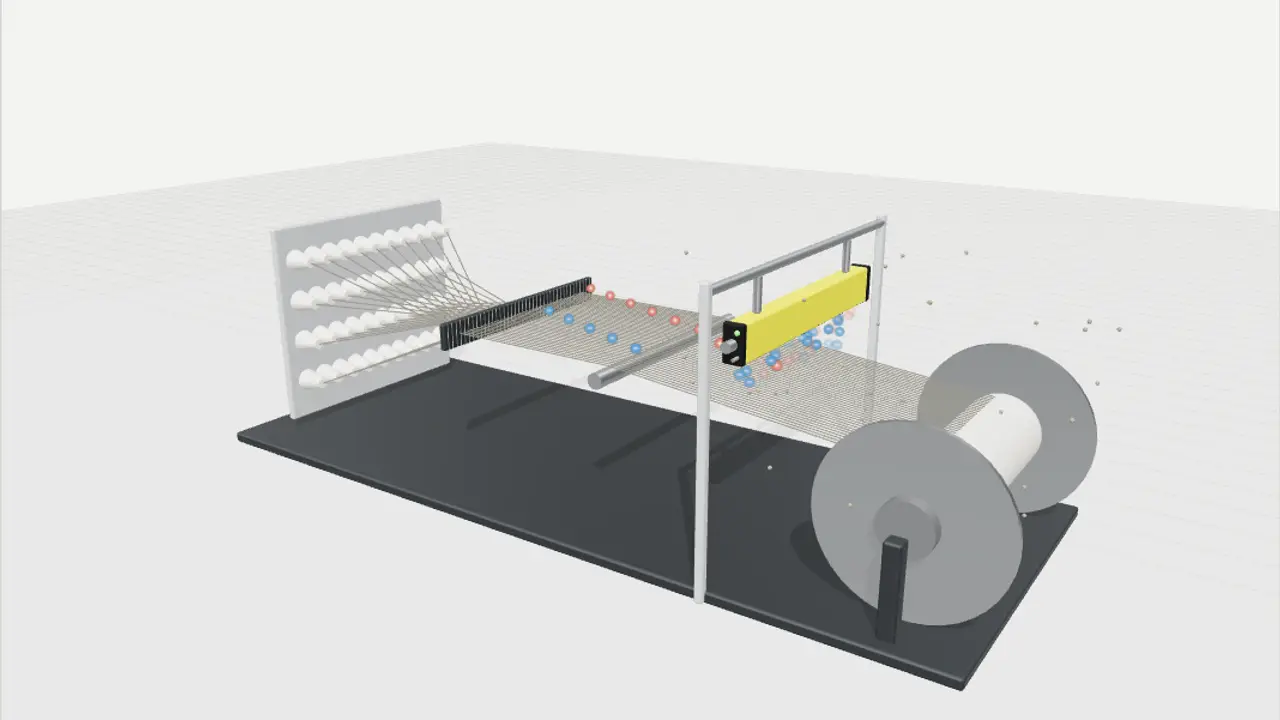
Textile warping / beaming machine with SE-DCB-110
Thousands of synthetic yarns are pulled at high speed from the creel and wound onto a large beam. Friction against the thread guides charges them: the yarns repel each other ("ballooning"), stick to rollers or snap — uneven tension, tangling, stops — and the charged beam shocks operators and pulls in dust and lint. An SE-DCB-110 across the whole width of the yarn sheet, just before the beam, neutralises the threads so they stay parallel under even tension.
The problem
In textile manufacturing, thousands of individual synthetic yarns (polyester, nylon, acrylic) are pulled at very high speeds from a creel to be wound onto a large beam. This rapid movement and friction against thread guides generate intense static electricity. The charged yarns repel each other (causing "ballooning"), stick to machine rollers, or snap. This leads to uneven tension, tangling, and frequent machine stops. Furthermore, the massive static buildup in the finished beam can cause painful shocks to operators and attract significant amounts of dust and lint, degrading fabric quality.
The solution
An active ionizing bar is installed across the entire width of the yarn sheet, just before it is wound onto the beam. By flooding the moving threads with positive and negative ions, the static charge is neutralized instantly. This ensures the yarns remain parallel and under uniform tension, allowing for a dense, high-quality beam and preventing operator shocks during handling.
Application
High-speed warping, beaming, and sizing processes in the production of synthetic and blended textiles.
1 · SE-DCB-110 — yarn sheet before the beam
Across the entire width of the yarn sheet, just before it is wound onto the beam; the pins point down at the moving threads.
- Ionization
- 11 kV pulsed DC · shockless
- Ionization range
- 100 – 600 mm
- Ordering length
- 300 – 4500 mm (100 mm steps)
- Supply
- 24 V DC · SE-PSU-24-C-M12
Also suitable for warping and beaming
Other FÖGE antistatic bars for textile yarn sheets.
Schematic model, not to scale. Machines and parts are generic — no specific manufacturer or brand.