Injection moulding: mould release with the SE-DCN pulsed DC nozzle bar
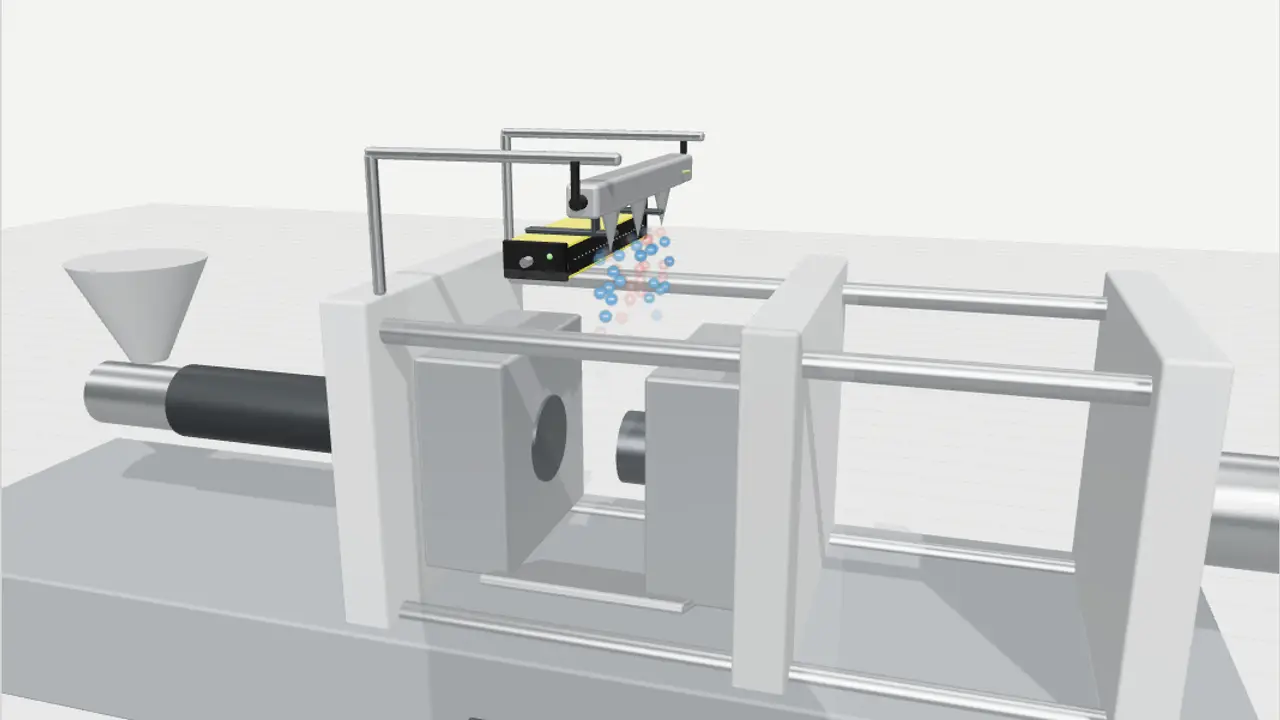
Static charge makes moulded parts stick to the mould core or cavity instead of ejecting. When the mould closes on a stuck part, the mould faces are damaged and the machine stops. The SE-DCN above the parting line ionizes and blows into the gap between the open mould halves: the charge is neutralised and the air blast releases the part.
The problem
High-speed injection molding of precision parts—whether for medical devices, pharmaceutical packaging, or chemical-resistant labware—creates intense friction and heat. This leads to massive static buildup on both the plastic part and the metallic mold surfaces. The resulting electrostatic attraction causes parts to stick to the mold cavity or core instead of ejecting cleanly. When the mold cycles for the next shot with a stuck part still inside, it causes severe mechanical damage to the expensive mold faces, creates crushed "short shots," and results in costly machine downtime.
The solution
High-output ionizing air blowers or specialized ionizing nozzles are positioned to target the open mold face during the ejection cycle. By flooding the mold cavity with a balanced stream of positive and negative ions, the static bond is instantly neutralized. This allows the parts to release effortlessly and fall away cleanly, ensuring the mold is clear for the next cycle and preventing any physical damage to the tooling.
Application
Automatic part release and mold protection for high-volume injection molding of plastic components, chemical containers, medical syringes, and pharmaceutical vials.
1 · SE-DCN — above the parting line
Emitter face and air nozzles aimed into the gap between the open mould halves.
- Ionization
- 11 kV pulsed DC · shockless
- Ionization range
- Up to 600 mm
- Air
- 6 bar · 10 mm hose · dry, filtered
- Supply
- 24 V DC · SE-PSU-24-C-M12
- Connector
- M12 · 4-pin cable
- Lengths
- 300 – 2000 mm
Also suitable for injection moulding
Other FÖGE ionizers used at injection moulding machines.
Schematic model, not to scale. Machines and parts are generic — no specific manufacturer or brand.