
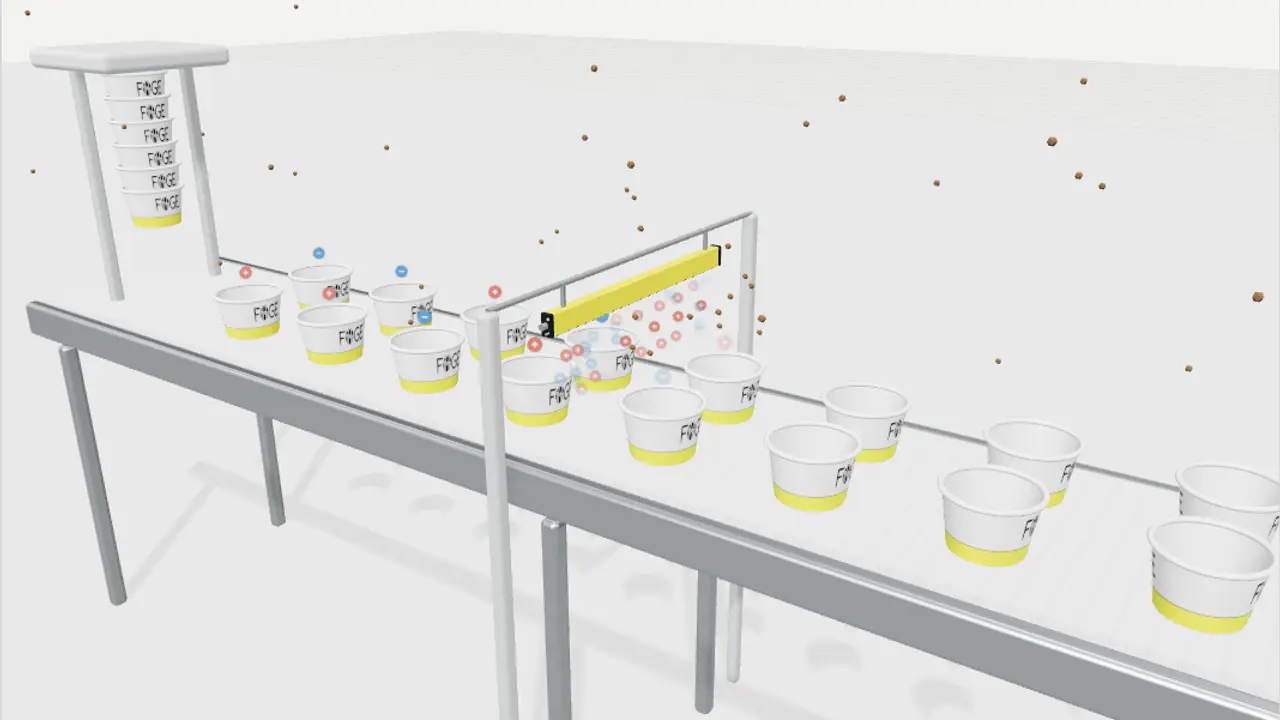
In-mould labelled (IML) containers on the line with SE-DCB-110
IML containers charge up strongly during moulding, stacking and de-nesting. The charge acts like a magnet: airborne dust and contaminants are pulled into the open containers before they are filled, and operators handling the stacks get shocks. An SE-DCB-110 above the conveyor showers the containers with positive and negative ions as they pass underneath — no new dust is attracted, existing dust is released and the shock hazard is gone.
The problem
Plastic containers generate significant static charges during the molding, stacking, and unstacking (de-nesting) processes. As shown by the warning icons in the image, this high static charge acts like a magnet, attracting airborne dust and contaminants into the open containers before they can be filled. It also presents a painful electrical shock hazard to operators handling the stacks.
The solution
Overhead active ionizing bars generate a continuous shower of positive and negative ions. This neutralizes the containers as they pass underneath, preventing dust attraction, releasing any existing dust (often combined with an air blower to remove it), and eliminating the shock hazard.
Application
Transporting, separating (de-nesting), or stacking empty plastic containers, tubs, or trays on a packaging or filling line.
1 · SE-DCB-110 — over the containers
Across the conveyor after the de-nesting station, about 150 mm above the open containers; the pins point down into them.
- Ionization
- 11 kV pulsed DC · shockless
- Ionization range
- 100 – 600 mm
- Ordering length
- 300 – 4500 mm (100 mm steps)
- Supply
- 24 V DC · SE-PSU-24-C-M12
Schematic model, not to scale. Machines and parts are generic — no specific manufacturer or brand.