
Automated headlight lens coating preparation with three SE-BLC-F-75-C
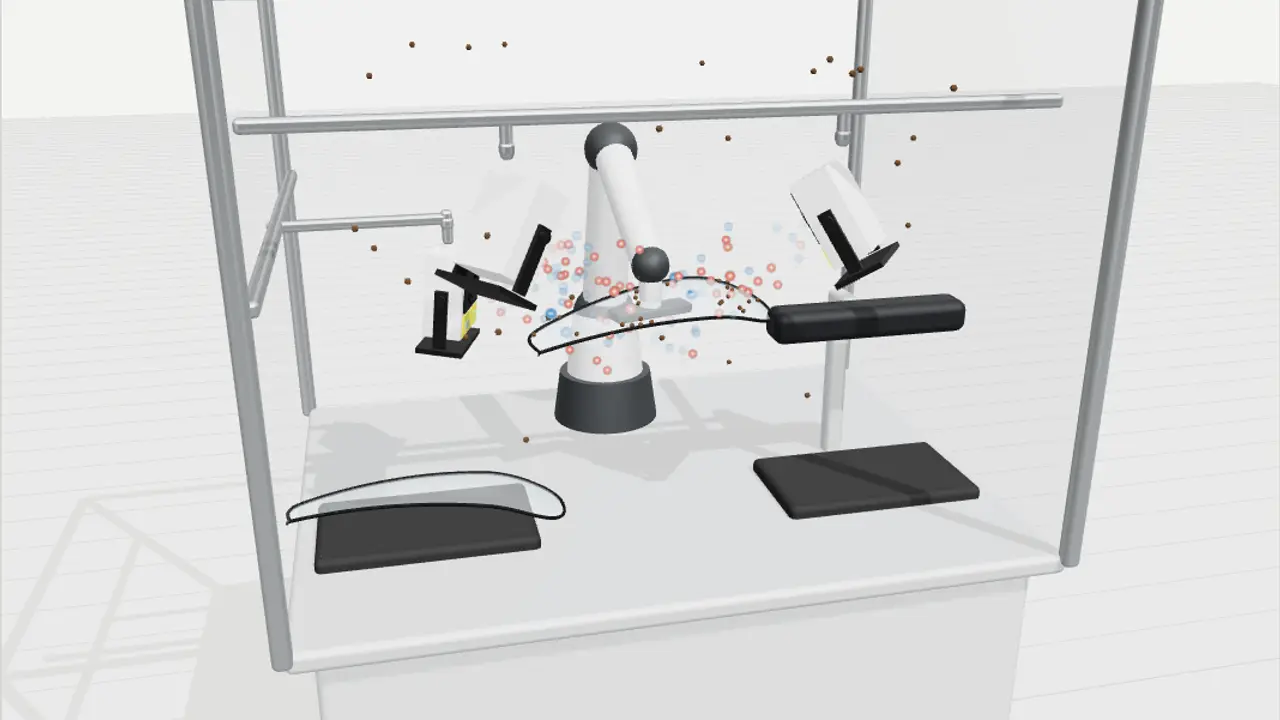
Clear polycarbonate headlight lenses charge up strongly during moulding and handling and pull in airborne dust. Dust on the lens before hard-coating, anti-fog coating or final sealing becomes a permanent defect — rejected parts and impaired light distribution. Inside the enclosed station, three SE-BLC-F-75-C blowers flood the complex 3D shape of the lens with balanced ions while the robot presents it from all sides, breaking the electrostatic bond so the dust is carried away before the coating head.
The problem
Clear polycarbonate automotive headlight lenses generate high static electricity during molding and handling. This static strongly attracts airborne dust and contaminants. If dust settles on the interior or exterior of the lens before hard-coating (anti-scratch), anti-fog coating, or final unit sealing, it causes permanent visual defects, rejected parts, and impaired light distribution.
The solution
Multiple ionizing blowers are positioned within the enclosed workstation to flood the complex 3D shape of the headlight lens with a high-volume stream of positive and negative ions. This completely neutralizes the surface charge, breaking the electrostatic bond holding dust particles to the plastic and preventing any further contamination during the critical coating or sealing phase.
Application
Neutralizing static charge and preventing dust attraction on 3D molded automotive lighting components (lenses and housings) immediately prior to protective coating application or final assembly.
1–3 · SE-BLC-F-75-C — inside the station
Two above the front of the cell and one at the side, each on its adjustable bracket and aimed at the zone where the robot presents the lens — together they reach every side of the 3D lens.
- Ionization
- Pulsed DC · shockless · balanced
- Ionization range
- Up to 500 mm
- Decay time
- 1 kV → 100 V in < 7 s at 500 mm
- Pin cleaning
- Integrated automatic brush
- Supply
- 24 V DC · M12 5-pin
Also suitable for coating preparation
Other FÖGE ionizers for enclosed lens and housing stations.
Schematic model, not to scale. Machines and parts are generic — no specific manufacturer or brand.