
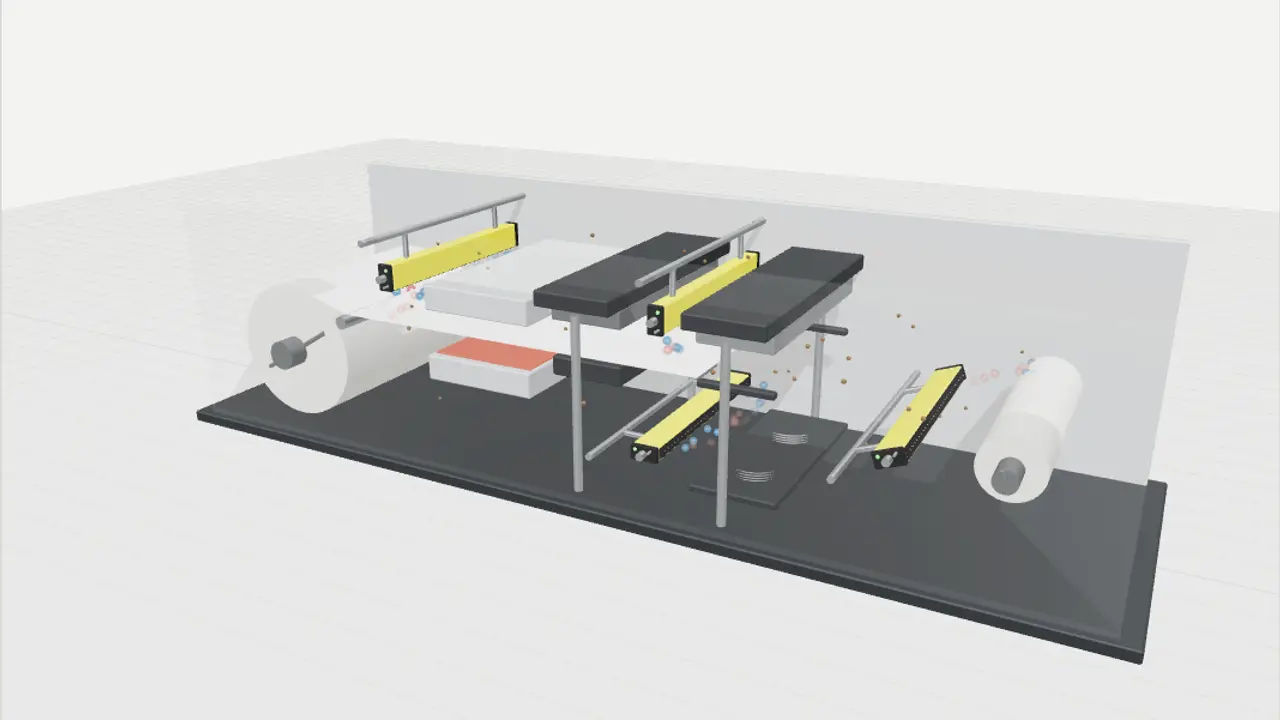
Foam plate thermoforming line with four SE-DCB-110 bars
Foam sheet is an almost perfect insulator and holds static stubbornly. A spark can ignite flammable blowing agents, formed plates stick to the mould and to each other so they cannot be stacked automatically, and the charged foam pulls in dust — a hygiene problem for food packaging. SE-DCB-110 bars at every critical point — after the unwind, between forming and cutting, at the plate stack and at the skeleton rewind — remove the charge so the plates release cleanly, stack neatly and stay dust-free.
The problem
In the production of expanded polystyrene (EPS) foam plates and food trays, the extrusion and winding of the foam sheet generate immense static charges. Foam is a near-perfect insulator, meaning it holds onto static stubbornly. This leads to several critical issues: - Explosion Risk: If flammable blowing agents (like butane or pentane) are used in the foaming process, a single static spark can cause a catastrophic fire or explosion. - Product Sticking: After the plates are stamped/thermoformed, they aggressively stick to the mold or to each other, making automatic stacking impossible. - Contamination: The charged foam acts as a massive magnet for airborne dust, which is a major hygiene violation in food-grade packaging.
The solution
A multi-point static control system is utilized. Long-distance ionizing bars are placed at the primary unwind and rewind stations to manage the bulk charge. For the thermoforming and stacking area, ionizing air blowers or targeted bars neutralize the individual plates as they are cut. This ensures the plates release cleanly from the mold, stack neatly without "nesting" issues, and remain 100% dust-free for food safety compliance.
Application
High-speed extrusion and forming of foam plates, egg cartons, meat trays, and take-away food containers.
1 · SE-DCB-110 — unwind
Above the foam sheet after the unwind roll; removes the bulk charge before the oven.
- Ionization
- 11 kV pulsed DC · shockless
- Ionization range
- 100 – 600 mm
2 · SE-DCB-110 — formed sheet
Above the formed sheet between the forming station and the cutting press; the plates release cleanly from the tools.
- Ionization
- 11 kV pulsed DC · shockless
- Ionization range
- 100 – 600 mm
3 · SE-DCB-110 — plate stack
Beside the plate stack below the cutting press; the plates fall flat and stack without sticking together.
- Ionization
- 11 kV pulsed DC · shockless
- Ionization range
- 100 – 600 mm
4 · SE-DCB-110 — skeleton rewind
Below the skeleton web, aimed into the nip of the rewind roll — no charge is wound into the roll, no sparks.
- Ionization
- 11 kV pulsed DC · shockless
- Ionization range
- 100 – 600 mm
Also suitable for foam thermoforming
Other FÖGE antistatic bars for foam sheet, plates and trays.
Schematic model, not to scale. Machines and parts are generic — no specific manufacturer or brand.