
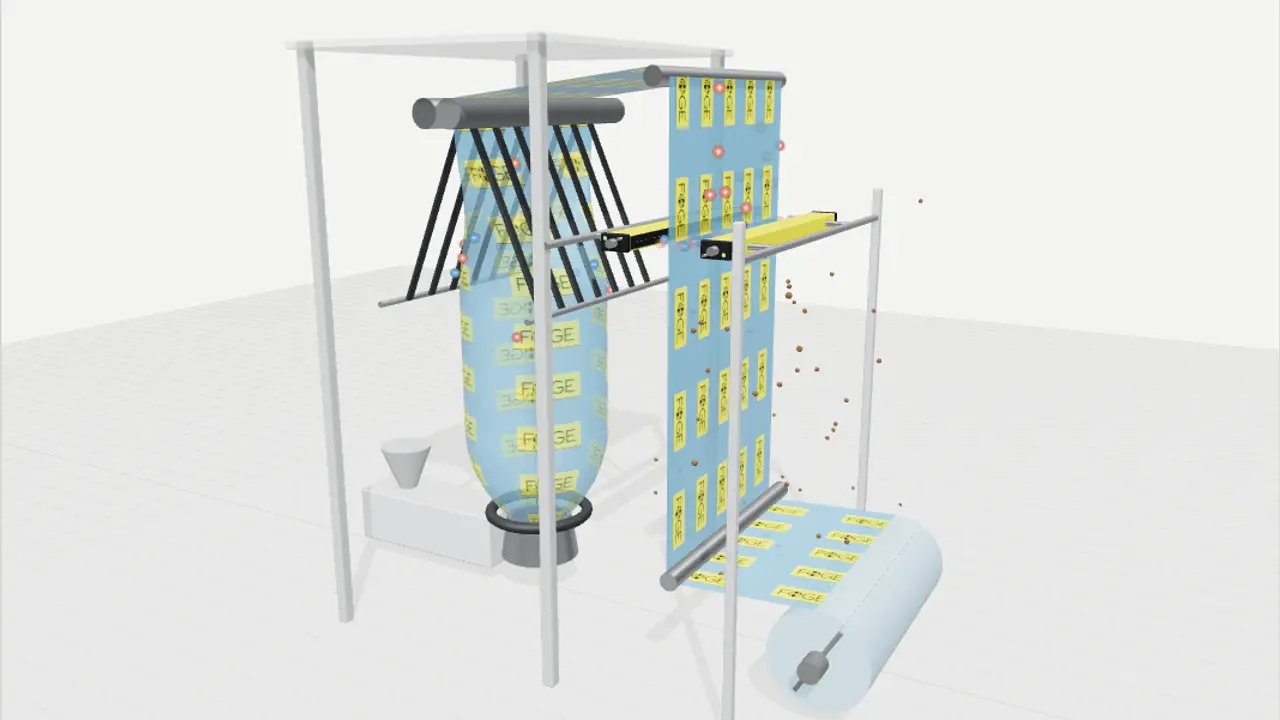
Blown film extrusion — take-off / collapsing section with two SE-DCB-110 bars
Molten plastic is blown into a bubble, stretched, cooled and pulled through the collapsing frame and the nip rollers. This generates extreme static charge — high enough to be dangerous to operators. The charged film clings to the collapsing boards, attracts dust and causes winding problems downstream. Two SE-DCB-110 bars on both sides of the lay-flat film, right after the nip rollers, neutralise the film before it goes down the tower.
The problem
In blown film extrusion, molten plastic is blown into a massive bubble, stretched, cooled, and then pulled through a collapsing frame and tight nip rollers. This extreme process generates massive levels of static electricity—often high enough to be physically dangerous to operators. This extreme charge causes the film to cling aggressively to the collapsing boards (causing wrinkles or scratches), powerfully attract airborne dust, and create severe winding issues downstream.
The solution
Because the initial charge is so extreme, a "hybrid" two-stage system is required. First, a passive static brush (or tinsel) is installed to safely bleed off the massive bulk charge down to a manageable level. Immediately following it, an active ionizing bar is positioned to neutralize the remaining residual charge down to zero, ensuring the film is perfectly neutral before it proceeds down the tower.
Application
Safely neutralizing the extremely high, dangerous static charges generated during the high-stress extrusion, cooling, and collapsing phases of blown plastic film manufacturing.
1 · SE-DCB-110 — inner surface
On the tower side of the lay-flat film, right after the nip rollers; pins face the film surface.
- Ionization
- 11 kV pulsed DC · shockless
- Ionization range
- 100 – 600 mm
- Ordering length
- 300 – 4500 mm (100 mm steps)
- Supply
- 24 V DC · SE-PSU-24-C-M12
2 · SE-DCB-110 — outer surface
Directly opposite bar 1 on the outer side of the film, so both surfaces are neutralised before the film goes down the tower.
- Ionization
- 11 kV pulsed DC · shockless
- Pins
- Tungsten · pin current < 250 μA
- Connector
- M12 · 4-pin cable
- Protection
- IP65 (with connector)
Also suitable for blown film lines
Other FÖGE antistatic bars for the take-off section of blown film extrusion.
Schematic model, not to scale. Machines and parts are generic — no specific manufacturer or brand.